
Wednesday, July 07, 2010
this weekend
My favorite retail show of the year is this weekend, the Palo Alto Clay and Glass Festival. I love this show because the selling is good, the customers love ceramics, I get to hang out with my pottery posse, and it's in the summer. I'm usually kind of losing my mind before Palo Alto, but this year I'm pretty together. I actually started packing today, which I don't think has ever happened this far in advance. You can take a peek here at some of the work I'll be bringing. Hope to see you there!

Saturday, July 03, 2010
new nested bowls
I love to make items that nest inside each other. Nested pieces are a visual surprise and delightful to me, and I think most people agree. The first thing I ever made that nested were the lotus bowls, about 14 years ago. I was o bsessed with the lotus flower at that time, and I was trying to figure out a way to emulate its shape in clay. At that time I was just starting to carve edges of bowls to make flower bowls, and I was very pleased with the concept of carving away to make new shapes. I tried to make a bowl with carved and layered petals on the inside, but the results were not pleasing. All of the sudden I realized I should make the bowls separately to get the layered effect I wanted, and I had my first set of nesting bowls. They were a set of four. I wish I knew where they are now, I probably sold them for $50.
I've made dozens of different kinds of nesting bowls and plates since then. My most recent thing was a set of nesting ranunculus bowls. Most people don't know what a ranunculus is, so I may need to chan ge the name to "rose nesting bowls" so I can stop explaining to people what they are. Ranunculus are very rosy in a way, though a lot more interesting to my eye.
The bowls were inspired after a visit to Neicy Frey's painting studio in Spokane, Washington. Neicy paints big beautiful canvases of brightly colored and delicately rendered flowers, including the ranunculus. Did I mention that the ranunculus is one of my favorite flowers? When I got back to my own studio it hit me to make some ranunculus bowls that nest. It was so obvious, I couldn't believe I had not thought of it before.
The ranunculus bowls turned out to be one of the more difficult things I've made in a while. Making bowls nest is easy when the rims are open-- all you have to do is measure the height and width. But to make these bowls really work, I had to make them curve in, so I had to measure height and width on the inside and outside. It was very slow going. I made several sets of three and five, a set of seven and a set of eight. The set of eight is a little big and scary, and at this moment I still have no idea what color to glaze them.
I made sets on two different occasions to test out the measuring formula, and strangely enough the first round I made fit better than the second round. This confirms my theory yet again that the best work is always done when one is freshly inspired and not yet weighed down too much with the possibilities of what can go wrong or trying to avoid a problem that one had the last time.
These bowls are on sale here and here. And I will have all of them at the Palo Alto Clay and Glass Festival next weekend if you want to stop by and check them out!
 bsessed with the lotus flower at that time, and I was trying to figure out a way to emulate its shape in clay. At that time I was just starting to carve edges of bowls to make flower bowls, and I was very pleased with the concept of carving away to make new shapes. I tried to make a bowl with carved and layered petals on the inside, but the results were not pleasing. All of the sudden I realized I should make the bowls separately to get the layered effect I wanted, and I had my first set of nesting bowls. They were a set of four. I wish I knew where they are now, I probably sold them for $50.
I've made dozens of different kinds of nesting bowls and plates since then. My most recent thing was a set of nesting ranunculus bowls. Most people don't know what a ranunculus is, so I may need to chan
 ge the name to "rose nesting bowls" so I can stop explaining to people what they are. Ranunculus are very rosy in a way, though a lot more interesting to my eye.
The bowls were inspired after a visit to Neicy Frey's painting studio in Spokane, Washington. Neicy paints big beautiful canvases of brightly colored and delicately rendered flowers, including the ranunculus. Did I mention that the ranunculus is one of my favorite flowers? When I got back to my own studio it hit me to make some ranunculus bowls that nest. It was so obvious, I couldn't believe I had not thought of it before.
The ranunculus bowls turned out to be one of the more difficult things I've made in a while. Making bowls nest is easy when the rims are open-- all you have to do is measure the height and width. But to make these bowls really work, I had to make them curve in, so I had to measure height and width on
 the inside and outside. It was very slow going. I made several sets of three and five, a set of seven and a set of eight. The set of eight is a little big and scary, and at this moment I still have no idea what color to glaze them.
I made sets on two different occasions to test out the measuring formula, and strangely enough the first round I made fit better than the second round. This confirms my theory yet again that the best work is always done when one is freshly inspired and not yet weighed down too much with the possibilities of what can go wrong or trying to avoid a problem that one had the last time.
These bowls are on sale here and here. And I will have all of them at the Palo Alto Clay and Glass Festival next weekend if you want to stop by and check them out!
Thursday, June 17, 2010
publicity, or my martha story
About 18 months ago, I was sitting at JFK waiting to get on a plane after another disappointing, soul-killing, wholesale show. My cell rang, and it was an editor from Martha Stewart Weddings. I actually said to her , "I've been waiting for your call, what took you so long?" She laughed. She wanted some of my cupcake stands, pronto, for the magazine. I don't think I have to tell you that landing a spot in Martha is the equivalent of winning the publicity lottery. I sent the cupcake stands, and waited for my free copy of the magazine that they usually send you when your item has been featured in a magazine. A couple of months go by. Finally I email the editor and ask what's up? She kindly informs me that I've been bumped to the website only. Another 6 months go by, and I get another call from her asking for a collection of cherry blossom stuff, in pink. I send it out, fingers crossed. This time I get my magazine, and I almost hyperventilate with excitement, my head filled with visions of the massive retail orders I'm about to receive. I look through the magazine, once, twice, three times. Where the hell am I? I finally find an image of my cherry blossom plate, about the size of a dime, on the fold in a mix of other product. Worse, it's layered on top of another plate, making it look like I've made that plate too. To date, I've only received inquiries about that plate underneath!
It is impossible to underestimate the importance of publicity for your business. The first time I received some major publicity was a feature article on the front page of the "Living" section of the San Francisco Chronicle. Since this was back when newspapers were still major sources of information (2004), it generated a lot of attention, which equals a lot of orders. I had a retail show soon thereafter and I literally had people lined up all day long, which was a first. Still hoping it's not a last. After the Chronicle interview, I was able to pay off my student loan. It was also a small launch pad that took me up a notch in recognition, and generated more publicity. If you look at my press page, press mentions have steadily followed after that interview.
People always ask me how I get press, and my honest answer is, "not much" which is totally unhelpful, I know. That Chronicle article was generated by a publicist the Clay and Glass Association of California hires to promote the Clay and Glass Festival, but every other press thing has been editors and writers finding me.
I'm considering hiring a publicist who specializes in working with artists. When I was first starting out and thinking about generating press, I read about how artists are supposed to put together a press packet, and send it out to editors. I've never done that. I'm not sure what the protocol is nowadays, with all of the distractions and information flowing. One thing I do know is editors at magazines, blogs, etc, need to find us, they want to find us, because fresh, interesting "product" is essential to keeping their readers attention. What have you done to get publicity? Or are you like me, just laying around and waiting for it to come to you? I'm still waiting for Martha to call again, I think third time has to be the charm.
 , "I've been waiting for your call, what took you so long?" She laughed. She wanted some of my cupcake stands, pronto, for the magazine. I don't think I have to tell you that landing a spot in Martha is the equivalent of winning the publicity lottery. I sent the cupcake stands, and waited for my free copy of the magazine that they usually send you when your item has been featured in a magazine. A couple of months go by. Finally I email the editor and ask what's up? She kindly informs me that I've been bumped to the website only. Another 6 months go by, and I get another call from her asking for a collection of cherry blossom stuff, in pink. I send it out, fingers crossed. This time I get my magazine, and I almost hyperventilate with excitement, my head filled with visions of the massive retail orders I'm about to receive. I look through the magazine, once, twice, three times. Where the hell am I? I finally find an image of my cherry blossom plate, about the size of a dime, on the fold in a mix of other product. Worse, it's layered on top of another plate, making it look like I've made that plate too. To date, I've only received inquiries about that plate underneath!
It is impossible to underestimate the importance of publicity for your business. The first time I received some major publicity
 was a feature article on the front page of the "Living" section of the San Francisco Chronicle. Since this was back when newspapers were still major sources of information (2004), it generated a lot of attention, which equals a lot of orders. I had a retail show soon thereafter and I literally had people lined up all day long, which was a first. Still hoping it's not a last. After the Chronicle interview, I was able to pay off my student loan. It was also a small launch pad that took me up a notch in recognition, and generated more publicity. If you look at my press page, press mentions have steadily followed after that interview.
People always ask me how I get press, and my honest answer is, "not much" which is totally unhelpful, I know. That Chronicle article was generated by a publicist the Clay and Glass Association of California hires to promote the Clay and Glass Festival, but every other press thing has been editors and writers finding me.
I'm considering hiring a publicist who specializes in working with artists. When I was first starting out and thinking about generating press, I read about how artists are supposed to put together a press packet, and send it out to editors. I've never done that. I'm not sure what the protocol is nowadays, with all of the distractions and information flowing. One thing I do know is editors at magazines, blogs, etc, need to find us, they want to find us, because fresh, interesting "product" is essential to keeping their readers attention. What have you done to get publicity? Or are you like me, just laying around and waiting for it to come to you? I'm still waiting for Martha to call again, I think third time has to be the charm.
Sunday, May 23, 2010
policing your policies
Over the years I’ve been forced to develop policies in my business. If you do not have policies in place, your customers will find that weak spot and exploit it, whether they mean to or not. I used to resist having policies, and frankly, I hate having policies. Like most artists, I like to have an open, fluid approach to issues and not be rigid with a policy or rule. And with everything else I do, I've had to learn the hard way that having policies is just
 part of having a sane business. For instance, I used to never take deposits on custom orders because I like to work for the money. Also, people can’t rush me when the piece isn’t paid for yet. I had to create a policy around deposits for big orders because of a person who ordered a huge dinnerware set and then never called me again after I sent her the first samples. I had to find out from her decorator that she did not like them and was done with the project. If she had $500 invested into the order she probably would have been more inclined to work with me on the design. That was very disappointing, but I couldn’t get mad at anyone but myself for not taking a deposit in the first place.
I thought I had myself pretty well covered on policies until I realized I didn't. I had a customer who bought a piece from me at a show last Christmas season, a gift, and this person asked me if he could exchange it if the recipient didn’t like the piece. What kind of fool doesn’t like my pieces in the first place, I don’t know, but apparently the customer was worried that he may know one. I made a mistake right then and there by kind of shrugging and saying, “I don’t really do exchanges, but if you get back to me right away, we can probably work something out.” What I should have said is, “You have x amount of days to make an exchange on anything you're not happy with.” I've been in business for well over 10 years and I so rarely encounter people wanting to exchange pieces that I never made policy around it. And that’s the problem so many artists have, being ambiguous with policies because they hate having to lay down the law.
Months later, I get a message from this customer, though I don't realize at the time that it's this exact customer. He asks me to open my studio on the weekend because he wants to bring his girlfriend over to select something. Since I think I have a sale on the hook, I have no problem opening in the middle of a Sunday afternoon. Turns out he didn't want to buy anything, he wants to exchange one of the pieces he bought at Christmas. It's possible I scared this customer a little bit with the steam that came out of my ears, but I did the exchange because I knew right off this whole thing was my fault for having a vague exchange policy. And now, the law has been laid down, and I have a hard and fast exchange policy.
Bottom line, don't be like me and let your mistakes dictate when you create your policies. Everyone who sells something should have a return and exchange policy that covers everything from breakage to lost shipping, a deposit policy, shipping policies, payment policies. In fact, just taking a look at the policies in etsy shops is a good place to start. Not only for yourself should you have policies in place, it also is assuring to the customer that they know what kind of experience they are going to have with you. It makes you look all professional and stuff.
As a side note, I know it makes some of you squirm when I talk about my annoying customers. Believe me when I say I have the best customers a girl could possibly want, except for about 1%. My most annoying customers usually teach me a lot, so they are not totally useless!
Monday, May 10, 2010
note to self: there are no perfect answers
I had an interesting conversation the other day with my friend and fellow ceramic artist, Laura Zindel. I like talking to Laura because she's ahead of me on the learning curve when it comes to being a full-time, professi onal artist, and is very grounded about the realities of making a living as a ceramic artist. She's talked me off the ledge a couple of times over the years, and I take what she says to heart because... she knows. With every challenge that comes up in my work, she's already been there, like 10 times.
We were discussing the challenges of dealing with your ceramic work as a "product" versus dealing with it as "art". I think the idea that art can only be made as one, unique item dogs many of us who depend on production in order to make a living. For myself, I divide my work into two categories: the high production stuff that is definitely a "product," and my more one-of-a-kind pieces which I see as my "art". The trap, as I see it, is getting sucked into that deep ravine of demand that comes when you make that great item that everyone wants (ahem, bird cake stands) and forgetting that you are an artist. Strangely, you can even start looking down on your own work, totally forgetting that even your "products" were born from art to begin with.
For some reason the artist Sergei Isupov has been on both of our minds lately. Me, because I wish I could translate my painting and abstract ideas onto clay the way that guy does, and Laura because she thinks even someone as brilliant and genius-like as Sergei is deals with the exact same crap we do when it comes to the challenges of making art in a market where demand is high for his work, even at the fine art end where he is. As we discussed this issue, Laura said that there are no perfect answers to meeting high demand with pottery, not with the product, and not with yourself. I think an artist is always going to have personal issues with creating work in a production setting, because of the loss of the artist's energy through the replication of each piece. But what are the choices when you want to make a living making your stuff? Sergei, at the other end of things, still has to wake up every day and come up with a new idea, and deal with people who want the same thing that has already sold.
What I'm really starting to understand as my career advances, there are no perfect answers to many of the issues I face as an artist. There is only making, or giving up. And everyone, no matter what they do with their life, faces this issue of doing meaningful work in a world that demands major output. So I want to know from you: how do you keep the art in production? How do you find meaning in repetition? Most of all, how do any of us stay sane when we must wrestle with these issues on a daily basis?
In this vein, I highly recommend Kari Radasch's article, "Eyes Wide Open" where she discusses some of these issues.
 onal artist, and is very grounded about the realities of making a living as a ceramic artist. She's talked me off the ledge a couple of times over the years, and I take what she says to heart because... she knows. With every challenge that comes up in my work, she's already been there, like 10 times.
We were discussing the challenges of dealing with your ceramic work as a "product" versus dealing with it as "art". I think the idea that art can only be made as one, unique item dogs many of us who depend on production in order to make a living. For myself, I divide my work into two categories: the high production stuff that is definitely a "product," and my more one-of-a-kind pieces which I see as my "art". The trap, as I see it, is getting sucked into that deep ravine of demand that comes when you make that great item that everyone wants (ahem, bird cake stands) and forgetting that you are an artist. Strangely, you can even start looking down on your own work, totally forgetting that even your "products" were born from art to begin with.
For some reason the artist Sergei Isupov has been on both of our minds lately. Me, because I wish I could translate my painting and abstract ideas onto clay the way that guy does, and Laura because she thinks even someone as brilliant and genius-like as Sergei is deals with the exact same crap we do when it
 comes to the challenges of making art in a market where demand is high for his work, even at the fine art end where he is. As we discussed this issue, Laura said that there are no perfect answers to meeting high demand with pottery, not with the product, and not with yourself. I think an artist is always going to have personal issues with creating work in a production setting, because of the loss of the artist's energy through the replication of each piece. But what are the choices when you want to make a living making your stuff? Sergei, at the other end of things, still has to wake up every day and come up with a new idea, and deal with people who want the same thing that has already sold.
 What I'm really starting to understand as my career advances, there are no perfect answers to many of the issues I face as an artist. There is only making, or giving up. And everyone, no matter what they do with their life, faces this issue of doing meaningful work in a world that demands major output. So I want to know from you: how do you keep the art in production? How do you find meaning in repetition? Most of all, how do any of us stay sane when we must wrestle with these issues on a daily basis?
In this vein, I highly recommend Kari Radasch's article, "Eyes Wide Open" where she discusses some of these issues.
Monday, May 03, 2010
new routine
After my last post about my struggles to get work done while dealing with constant interruptions, I decided it was time to step back and take a look at what I could do to mitigate some of the problems. That's how I do it: lose mind, then fix problem. It would be nice if I could deal with my problems before I have a meltdown, but I usually don't notice a problem until the red lights are flashing, the alarm bells are going off, and people are running away, screaming and waving their arms. Some call it denial, I call it supreme focus on what's in front of me.
One of the things I had to look at was my routine. I love my little routine. In fact, I'm married to it. One of the reasons why I work for myself is because I like to do what I want to do, when I want to do it. Many years ago I developed a routine of getting my exercise in the morning and then starting work around noon. So civilized. But the problem with walking into the door at noon is that half the day is already gone, and I'm at my very best in the morning. By 2 pm, I feel the clock is really winding down. By 6 pm I really want to be home. So actually, it's ridiculous that I spend my best brain time at the gym. I've done it that way because then I get the exercise thing off my list for the day, and as the day goes on I get lazier and lazier about getting my heart rate up.
But, something had to give, and I decided that I could try to get into the studio first thing in the morning, before anyone else is there, and then go to the gym or yoga class later. So far, the routine is much better for me as far as getting more done with less in the way of interruptions, though I have skipped the gym a couple of times which makes me feel guilty. But, I think I can work with this new routine and perhaps someday, in the near future, be happy enough with it to marry this one, too.
The second thing I had to look at was my own self-indulgence and lack of discipline. Often, when I am working on something, I'll suddenly remember something else that I need to do and I will immediately drop the first thing and move onto the second thing. I can do this all day. I hate how it makes me feel, all scattered and nuts. So in the past couple of weeks when I find myself about to go pour molds when I'm in the middle of loading a kiln, I won't let myself do it. I wait for the logical break in whatever I'm doing, then go and do the other thing that is calling to me from across the studio. On busy days I've started making an hour by hour schedule for what I want to do that day so I'm less likely to start trimming bowls when I'm in the middle of wedging because I suddenly realize the bowls are getting too dry. I think it's called "organizing." I recommend that everyone give it a try!
One of the things I had to look at was my routine. I love my little routine. In fact, I'm married to it. One of the reasons why I
 work for myself is because I like to do what I want to do, when I want to do it. Many years ago I developed a routine of getting my exercise in the morning and then starting work around noon. So civilized. But the problem with walking into the door at noon is that half the day is already gone, and I'm at my very best in the morning. By 2 pm, I feel the clock is really winding down. By 6 pm I really want to be home. So actually, it's ridiculous that I spend my best brain time at the gym. I've done it that way because then I get the exercise thing off my list for the day, and as the day goes on I get lazier and lazier about getting my heart rate up.
But, something had to give, and I decided that I could try to get into the studio first thing in the morning, before anyone else is there, and then go to the gym or yoga class later. So far, the routine is much better for me as far as getting more done with less in the way of interruptions, though I have skipped the gym a couple of times which makes me feel guilty. But, I think I can work with this new routine and perhaps someday, in the near future, be happy enough with it to marry this one, too.
The second thing I had to look at was my own self-indulgence and lack of discipline. Often, when I am working on something, I'll suddenly remember something else that I need to do and I will immediately drop the first thing and move onto the second thing. I can do this all day. I hate how it makes me feel, all scattered and nuts. So in the past couple of weeks when I find myself about to go pour molds when I'm in the middle of loading a kiln, I won't let myself do it. I wait for the logical break in whatever I'm doing, then go and do the other thing that is calling to me from across the studio. On busy days I've started making an hour by hour schedule for what I want to do that day so I'm less likely to start trimming bowls when I'm in the middle of wedging because I suddenly realize the bowls are getting too dry. I think it's called "organizing." I recommend that everyone give it a try!
Tuesday, April 13, 2010
you thought I made pottery? silly you.
Lately, I've been feeling like a squirrel with ADD. I have so many tasks to deal with every day, I can only focus my attention on 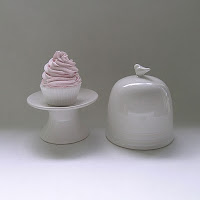 any one thing for a few minutes before my concentration is broken by another task pulling at me. This is slowly driving me absolutely crazy. I think most artists like to have long periods of uninterrupted time. I remember back in the day, before I got all "successful" that my days were nothing but long periods of unbroken concentration. I'm starting to think that's how I became so successful in the first place. Brain power, baby. Back then I would get so irritated with anything or anyone that got in between me and my pottery. Now, I can't allow myself to get irritated like that because then I would walk around in a constant state of irritation.
 any one thing for a few minutes before my concentration is broken by another task pulling at me. This is slowly driving me absolutely crazy. I think most artists like to have long periods of uninterrupted time. I remember back in the day, before I got all "successful" that my days were nothing but long periods of unbroken concentration. I'm starting to think that's how I became so successful in the first place. Brain power, baby. Back then I would get so irritated with anything or anyone that got in between me and my pottery. Now, I can't allow myself to get irritated like that because then I would walk around in a constant state of irritation.
This is what my Tuesday morning looked like this week:
- get up and run to the studio at 8 am to unload the kiln and see what survived.
- run home, make ship tags for survivors, write "thank you" notes to customers (on this day, that was 9 notes) finish up editing my monthly newsletter and send to 1,000 people, and list a few things on Etsy. Oh, and answer about 8 emails.
- run back to the studio by 10 to meet with my assistant, Ruth. Ruth starts bubbling orders while I match the tags with the items. We can't box them because I'm totally out of boxes and we're waiting for a delivery from Uline.
- Right when Ruth finishes at 11, Uline arrives with boxes. Ruth moves on to glazing while I put away boxes and then box orders.
- Finish at 11:30, pull dogwood flowers from the mold and clean those for 30 minutes.
- At noon, wedge up some clay and thrown for an hour.
- At 1, the high school intern arrives. Spend 20 minutes with her getting her task lined up and organized. Then, I leave for lunch.
I've been not doing so well mentally for the past couple of months, and I'm just now starting to grasp that it's connected to the problem of broken concentration. This kind of short task mode is great for pumping out production, which is what I've been stuck doing because I've been shorthanded, but not great for making new work, or art. And that's the stuff that keeps me happy and jazzed about pottery. I've just hired another set of hands to help with production, and I'm really hoping that with her help, I will be back on the path to mental stability. Soon. I would like to know what you all do to give yourselves that long, luxurious period of focused attention to your work, especially when you have things like kids, assistants, or another job.
Subscribe to:
Posts (Atom)