Showing posts with label philosophy. Show all posts

Wednesday, June 15, 2016

nuance and variation

A couple of months ago, I was really struggling with process.  The issue was what I think of as copying myself. That probably sounds strange but the basic problem was re-making motifs that I like. I re-make them because I like them, but I was afraid that this approach will work me into a creative rut... again.  I've been very wary of anything that resembles production pottery. As a potter who makes a lot of stuff, this fear was making me a little crazy and jamming things up at the studio.
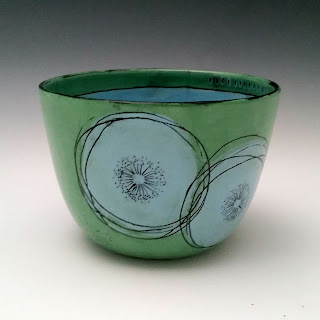
The very idea of "copying myself" brings with it a lot of judgement and that voice in my head, telling what's good, what's bad, what works, what doesn't. That voice stops me, I hold back. I don't want to make something that's bad or doesn't work. This is the crux of the main problem I have in the studio-- stopping myself.

The reason for stopping myself from doing anything is I don't want to "waste" materials or my time.  I also don't want to get stuck with "bad" work. When I break down this thought I have to reckon with the fact that the very idea of "wasting" time or materials in in itself a harsh judgement, and not really connected to anything real. The only wasted art material is the one not used. Wasted time is time spent on Facebook or other time I use up procrastinating. Making art that is not one's best work is not wasted time, it's just time used while you get better. It's unavoidable.

Rather than trying to not waste time or materials, I could be trying to use up as much time and materials in getting better. That's the only way. I can't think my way into being a better artist, I have to do it.

Getting back to the idea of copying myself and not generating new ideas. I mentioned it to my friend, Kathleen, who took in what I was saying and said very simply, "I don't think there is anything wrong with the idea of nuance and variation."  She said, "I like the idea of editions. You can work with the same concept but you try a slightly different approach each time."

One of  the reasons I like Kathleen is because she doesn't think like me at all, so I learn things. This was my little "ah-ha" moment. This concept  suddenly gave me permission to continue to explore these motifs that I like, but not have the fear that I would get stuck in them. Rather, look at them as ideas that will keep developing rather than as some arrival point. And suddenly, I was off and running again.


Tuesday, January 26, 2016

daily rituals

This is my second post in my series about how to manage the schedule of a creative business. If you missed my first post, read it!

 There has been a lot of interest lately in the daily ritual of artists and writers. I think it is a bit of a mystery how creative types manage to discipline themselves enough day after day to actually get their work done, while also indulging their creative whims that help fuel the work they do.  And making your way in the world as an artist, which means doing your own thing on your own terms, takes lots of discipline and self-control.

All of us want to be in the studio, but many of us have a hard time getting in there consistently and as I pointed out in my last post, consistency is key to running a successful creative business. So many things to do to prepare ourselves properly before we step into our creative space, so many cute cat pics to look at first.  The way to address this problem is with a daily ritual that will help you transition into your studio smoothly and without fuss, day after day.

The reason for the daily ritual is three fold:

  • One, it sets a daily pattern that alerts your brain to the fact that we are going to do some familiar and routine things, and then we are going to the studio. You're brain doesn't have as much of a chance to dream up exciting capers and out-of-studio adventures because you've given it notice that we are not doing that today, we're going to the studio and focusing on work. 

  • Two, a daily routine eliminates the need to make decisions about petty things and uses that brain power for more important things. It may seem silly, but it's well documented that humans only have the capacity to make so many good decisions in a day, and you don't want to use them up on mundane things, like what to eat for breakfast.

  • Three, the daily ritual is a weapon against procrastination. You're set with a routine that meets your needs, and over time it becomes a well-worn path that is easier and easier to follow. It's not difficult to dismiss the procrastinating actions that your brain tries to throw in your path because your ritual becomes more comfortable to execute than doing something else that you know is going to delay your entry into the studio. 

The daily ritual is all about transition-- transition from the your regular life to your creative life in the studio. You start developing your daily ritual by looking at what time of day and from what place you transition to your studio. For me, I'm transitioning from my home in the morning to my studio to work all day. So my daily ritual encompasses an everyday morning routine-- personal hygiene, exercise, meditation, breakfast, computer time, etc. I include all of these things in my daily ritual because once I'm in my studio, I don't want to be distracted by anything such as needing to get exercise, racing thoughts, anxiety about responding to a customer, or feeling hungry.  I've dealt with all of that stuff already and I don't have to think about it anymore.

If you are transitioning from a day job to your studio later in the day, you will have to take different factors into consideration. Or if you have a family to mange, even more components to evaluate. The only thing that matters is that you are taking a regular, repetitive action daily
that brings you comfort while addressing the things that may distract you once you are in the studio, so you can walk into the studio ready to focus. It must be something that you can look forward to so you don't mind doing it day after day. If your life is very chaotic with a lot of elements you can't always control, your daily ritual can be as simple as a cup of tea before doing your work. Or it can be very elaborate like mine, covering all of your basic needs.

I developed my daily ritual by making a detailed list of everything my most ideal self would do every day to make a perfect morning. It's true that things don't always go as planned and there are interruptions that throw my day off. But for the most part, my daily rituals sees to all of my needs and protects me from the chaos of my own mind. I would love to hear from you about your daily ritual, or struggles you have while trying to establish one.

My next post in this series will cover more of the nitty-gritty on how I divide my time up between all my tasks, how I streamline things, and how I keep a lid on the chaos.


Wednesday, December 30, 2015

the way of the half-ass

I've mentioned before that I am a recovering perfectionist. One of the ideas that I've embraced since going into recovery is the idea of half-assing it.  The mantra that goes with half-assing it is: "Half-ass is better than no ass". 

The idea first came to me around how I exercise. I'm one of those people who decides I'm going to get in shape and then sets up a whole regimen: daily routines, a DVD workout set from Jillian Michaels, a little notebook to mark my progress, etc. And I'm good with that for a few weeks or a month or whatever. But then... I get lazy, and I miss a day. Missing a single day is as good as driving the train off the tracks and into the gully, and I know it. I know that as soon as I am achieving at less-than-optimal standards, I give up. It's a symptom of my perfectionism.

But one day I was floundering with my exercise routine, and I decided that rather than skip the whole thing, which was my inclination because I was short on time that day, it would be better if I just took the 10 minutes I had a do some squats and some pushing around of the arm weights and that would be okay. It was half-assed compared to my usual effort, but also literally better than nothing, and the easiest and least I could do while still doing something. It also kept the train on the tracks. Since I came to the Way of the Half Ass, I've been getting more regular exercise.

Half-assing it also goes hand-in-hand with doing the easiest thing that is available to you rather than not doing it because you can't trust or value something that's too easy. This is another aspect of perfectionism: one must unduly suffer. If it's easy, it ain't worth doing. I really believed for years that I was not expressing my deepest artistic self unless it was hard and I was suffering in some way. But really, I think it was a finely tuned fear and procrastination system. I have been so much more creative in the past 18 months because I don't care as much about making "perfect" things anymore. I don't even care about finishing if I don't feel like it.

I think a lot of people out there who are running art-based businesses flounder with things like marketing and creative development because they think they can't do it unless they do it 100% "right", locked in with a beginning-to-end plan, executed with perfection. I say fuck that. Floundering around and doing things whether or not it's "the right way" or shows you at your very best creates its own forward momentum that is more valuable than sitting around in your studio thinking about all the things you're going to do as soon as the time is "right".

It's the things that I don't half-ass that haunt me more than the half-assed things I do. Right now I'm feeling overwhelmed by putting together a new marketing and promotion plan. I have to reach into new areas to get my work out there because my old way of doing things is not working anymore. The fact that I'm overwhelmed is my own little clue that I'm struggling with my perfectionism, and then nothing gets done because the whole thing makes me uncomfortable and I would rather procrastinate. It would be a far better thing to think of a few of the easiest things I could do right now-- send off a few emails to showrooms, ask for help-- than to sit alone in my head.

The bottom line of half-assing-- so to speak-- is not about lowering your standards, but about being kinder to yourself.  Stop with the lashing of the whip, stop with the impossible ideals, stop with the procrastination. Half-ass it. You'll feel better.


Wednesday, April 22, 2015

is this thing on?

Life has been strange, and strangely wonderful lately. First, I'm just gonna put something kinda uncomfortable out there. It may wreck your image of me as a highly successful potter. This year --so far--has been the very worst year for sales... ever, I think. I mean, in the 15 year history of my business. This month especially, April, has been the deadest month I've had in years.

I don't really want to go into it, I'm just mentioning this as a way to communicate my state of affairs. In a weird way I am grateful that things are slow, because it's giving me the freedom and the time to work on my new pieces, make some custom orders, and put time into other creative projects that I have going. I also think when my assistant left last year to move to Hawaii and I did not replace her, I was signaling to the Universe that I desire a change of pace. I feel like it's a transition time, for me, for my career-- if that's what it's called-- and that transitions are by nature temporary, challenging, uncomfortable, and what I'm feeling -- like I'm walking on a very high tightrope in a stiff breeze-- is normal and natural.

But goddammit, every once in a while I fucking freak out. I mean what the fuck?! Am I here? Am I alive? Is the internet working?! Is this thing on?!!!

I've been working out all kinds of strategies to deal with the anxiety. I'm doing yoga and meditating every single day, trying to overlay the chaos with a sheen of sanity. Ultimately I know that even if it's not temporary, this is somehow the new normal, being a wreck is not going to make it better. Being a wreck will make it harder and also make my husband miserable. He hates dealing with me when I'm a wreck.

I was having a small moment last week where I was feeling alone and adrift. Very quickly I wrote down some goals for the week, something to focus on and stay engaged rather than feel sorry for myself. I wanted to share them with you because I think these are all good goals to keep in mind if you are circling the drain:


  • Connect: with a stranger and with a friend. Write an email to someone you admire and tell them they are amazing. Even better, send them a postcard. I did both last week and it made me feel good. I also took the time to connect with a couple of friends who I've been out of touch with for too long.
  • Promote: something easy and something hard. The goal here was to get myself out of my comfort zone a bit when it comes to promoting. I can do my usual thing, but what about reaching out to a store, or to another artist and suggesting a collaboration, or submitting a story to a blog/website? This is hard for me, because I prefer to have people chase after me, but it gave me something to work on and feel like I was planting a seed or two. 
  • Finish: the thing you've dreaded and the thing you haven't made time for. We all know what that is in our lives. Get it done. You'll feel better.
  • Do: something for yourself and something for someone else. Taking care of oneself is the kindest thing any of us can do, and doing something for someone else is the next kindest. Make someone else's day while making sure you are taking care of yourself too.
And here, for your enjoyment, are some pictures of my some work that came out of the kiln last week. Yes, it's for sale, you can buy it.


Friday, December 12, 2014

slow ceramics

It's been an unusual holiday season for me, in that it has been remarkably slow. This has been by design. Of course I love the holiday bump and the attendant swelling of my bank account. What I don't love is the pressure cooker of holiday shopping, the timeline of trying to get handmade items to people by Christmas or Santa will explode and ruin every one's day.

I decided not to do any shows at all this year, with the exception of my own Open Studio and a pop-up I'm doing with friends. And I also decided that I would not participate in any Black Friday or Cyber Monday promotions by offering free shipping or other discounts. All those things do is create a bunch of extra work for myself, at a discount. One could argue that the value of these promotions is reaching new customers, and even though you are not making as much money per item, you are making it in bulk, which disguises the net loss.

But I oppose it on a philosophical level. Black Friday is nothing more than a media invention designed to panic people into spending money, and it has always disgusted me. I don't see why artists and makers should be participating in it when what we are offering is the very opposite of that kind of mindset. I just can't handle the dissonance of it anymore, and this is the year where I checked out. Cyber Monday, while not as gross on the face of it since it doesn't involve people getting squished to death in a Wal-Mart toy aisle, is still of the same ilk, designed to concentrate purchases on a single day to measure consumer spending.

I did have a sale on my own website, which I figured would reach my current customers and fans who keep an eye on what I do. Those are the people I want to reach, give a discount to. My customers are the ones who keep my business going all year. I don't have a business that needs bulk holiday sales to see me through the year, and I don't see why I should be selling discounted work to what usually amounts to a bunch of one-time customers.

All of this high-minded thinking has created the slowest holiday season I've ever had, which has given me moments of pause, but I feel like it's totally worth it. I've not worked any weekends, broken down into stress tears, or had unpleasant email exchanges with people who don't understand the term "made-to-order." I've been able to create an oasis of calm in my studio, to actually enjoy the season as we head toward the darkest day of the year.

And I'm creating a whole new body of work right now, and I'm completely immersed in it. The holidays are a side note to me compared to what I'm doing in the studio. The work is crazy labor intensive, taking hours and even days to produce a piece, which is the polar opposite of what I've been doing for years with running a production pottery.  It's slow ceramics, slow making, and I am loving it. The pleasure is so deep, and it's a pleasure I have not experienced in years. Because I also love selling my work-- a lot of it--I will probably figure out how to put some of these pieces into production and make them more widely available, but for now, I just want to ride this wave.


Wednesday, September 03, 2014

the problem with perfection

When people tell me they are a perfectionist, I take note. I am a recovering perfectionist and I’m interested in what being a perfectionist means to other people.  I generally regard perfectionism as a neurotic condition and I want to offer support, if possible, and learn more about letting go of perfectionism within myself.

Often people will say they are perfectionists with a little bit of pride. Proclaiming yourself a perfectionist is a sort of humble brag, because you are subtly sending the message that your standards are high, higher than most. And if your standards are higher than most then your work is probably better than most… right?

I’ve struggled with my own perfectionism because I believe my desire to be perfect and make perfect things has held me back from being a fully realized artist more than any other one of my tendencies. For me, being a perfectionist means rarely deriving satisfaction from the work I make because it’s not as good as I want it to be. That striving to be better is a trait of many artists, and I don’t think there is anything wrong with seeing how the work you just made would be even better if you did “x” differently. It’s called innovation and it’s how you get from A to Z and make amazing work. Amazing work doesn’t just come out of nowhere. Amazing work comes from lots of small failures and having the tenacity and drive to overcome each small failure. The problem with perfectionism is failure is often regarded not as a step forward, but as a sinkhole.

My studio is filled with half-realized ideas that did not come out as planned, so I drop it. My head is filled with ideas I’ve never tried because my perfectionistic fear-monger picks it apart before I give myself a chance to experiment. I started recognizing this tendency a while ago, and I’ve taken steps to recognize the voice of perfection, and dismiss it.  That voice disguises itself as a helpful friend who just wants you to make good work, and it's easy to confuse it with your intuition.

Given all the time I’ve spent thinking about perfectionism and trying to track it within myself and other people, I have some more ideas about the drawbacks of being a perfectionist:
  1. Being a perfectionist is just not fun, because you are more focused on controlling the outcome rather than focusing on the process. As an artist or creator of any kind, you gotta love process, because to make anything takes time and attention to take each step toward completion. If you lose your way with that and focus too much on how it's not perfect before you are even done, you've crushed your own creative joy. Keep doing that, and the Muse gets reluctant to come around.
  2. Unrecovered perfectionists will often try to use their perfectionism as a way to justify not sharing or completing their work because "it's not good enough yet." Perfectionism and procrastination hang out at the same club. They don't like to acknowledge each other because perfectionism thinks it's too good for procrastination, and procrastination doesn't like to acknowledge anything, but if you look closely they are swaying their hips to the same beat.
  3. All of us have holes in our hearts that we are trying to fill, and perfectionists have a hole in their heart that they are trying to fill with an impossible ideal. Clinging to an impossible ideal doesn't fill your heart, it seals it off and makes you defensive and careful. As artists and creators, we must unseal our hearts wherever we have resistance so we can communicate the truth and beauty of what we are hiding in there.
  4. Most perfectionists I know are workaholics. Again, these traits go to the same club, but they are besties, taking pride in one another. Like many "isms," perfectionism and workaholism function more as crutches rather than genuine support, and disguise our inner feelings of unworthiness and judgement.
  5. Being a perfectionist means living with the constant fear that you are never going to be good enough, and people are going to find out. While striving to be a perfectionist may temporarily soothe our troubled souls, in the end there is only you, imperfection, and the choice of whether or not to accept it.

I love that people like Brene Brown are spreading the concept of the gift of imperfection so widely. I hope that on some level it's changing the way we all think about ourselves and the world.  As I was thinking about how to finish up this post this morning I was asking myself what I think the greatest gift of imperfection is. My answer (to myself) was that being imperfect gives us the opportunity to keep trying, keep going, and keep the fires burning. There's no where to go from perfection because... it's perfect! You can't grow and learn from there, it's done. What do you think about the gift of imperfection? Put your perfectly imperfect answers in the comment box.

Friday, January 24, 2014

a new page

When some people want to change something in their life, they may buy a membership at the gym, join a like-minded group, enroll in a class, or get a therapist.

Me, I buy a notebook.


This is a collection of my notebooks. In the interest of full disclosure I will say that this is not all of them. All have been acquired within the past 3 years, with the exception of #12, my wedding notebook that my Aunt Shelly sent to me back in 2001 when I got engaged to my husband. She knows the power of the notebook.

I have always wished that I were the type of person who could carry around a moleskine notebook and jot all of my thoughts and ideas into that one place, and when I was done, file it and buy another exactly like it. And when I needed to refer back to something, a genius thought or creative idea-- of which I have many-- I could simply crack the moleskine. My inner creative life could be documented in a linear way that would create a beautiful pocket of order in my universe.

But that's not me. I am addicted to the new beginning a fresh notebook represents. When I decide I need to make a change in my life, such as getting more exercise,  a new notebook must be purchased (#15) so I can use that notebook as a way of tracking myself. I can't write down my daily exercise in notebook #10, which holds my grocery lists and menu plans, or notebook #21, which lists all the annoying household things that need to be taken care of, and certainly not notebook #9, which lists my studio to-do's for the day. Crossover creates confusion.

And it's not just lists of things that I like to have going. #14 is my daily journal (always spiral bound and college-ruled). #13 is strictly for pottery ideas and drawings, while #3 is for other creative ideas, like papercuts. #4 is dedicated to happiness and happiness resources á la Gretchen Rubin, and #7 stays in my purse for moments when I am struck by inspiration when out to dinner or a museum (empty except for notes on directions and places to eat). #3 was for when I decided to start doing sketches with little stories underneath, of which there are two in the past year (sketches, not stories), and somewhere in there is a notebook related to money, but I'm not sure which.

I'm going to confess what you probably saw coming from the beginning of this post: the only notebook that regularly gets any use is my journal, my day planner, and my sketch books. In large part, the rest of the notebook are testaments only to my ambitions, desires and goals. 

For people like me, who believe in the strength of words and writing, notebooks and paper hold a powerful sway over our psyches. As I was writing this post, and reading about notebooks and moleskines, I found this notebook, and my heart started beating a little faster. Maybe this is the ultimate notebook. Maybe this is the one that can change everything.

Friday, October 05, 2012

process is everything

I'm doing something a little weird right now, which is reading Thomas Keller's The French Laundry cookbook cover to cover.  The French Laundry is a Napa Valley restaurant about an hour away from where I live. I've never eaten there. I will eat there someday, and I know people who have eaten there and talked to them about the experience. The French Laundry creates two 9-course tasting menus every day for their customers, each course very small, and from what I've heard it takes hours to go  through the courses. The food is incredibly labor-intensive and made out of the highest quality ingredients, so the base price is $270 a person. It's not a casual meal and they are always booked out two months in advance.

Running a very high-end restaurant and a pottery studio has one major issue in common: every day you go in, and you create from scratch something over and over again. The major challenge is to not become bored, or to hurry through it with your mind elsewhere, or to become deadened to the process and just create by rote. All of these things have happened to me over the years, and when I'm there, I don't even like my job anymore and I feel like a failure. As an artist, this is the most painful place to be. Thomas Keller writes about maintaining passion for the endlessly repeated acts he performs in the kitchen, and he does this by giving each step his full attention. When you give something your full attention, no matter how mundane, you have the opportunity to be filled not with boredom and the urge to rush, but with a sense of wonder and pleasure with your process.

I know this, but still, I can find myself in the studio, banging stuff out as quickly as I can and just trying to get through the day. Reading Keller's cookbook has re-focused me in the studio and made me once again realize that the finished product is worthless to me if I don't enjoy the process.

Both potters and cooks know there are all of these steps that happen in between the idea of what you want to make, and then the finished product. Most of the time what you have at the end is not something that is perfect, or exactly how you imagined it. But this does not necessarily decrease its value.  Thomas Keller writes in his book that we must acknowledge there is no such thing as perfect food--or pottery-- only the idea of it. But that doesn't mean we don't strive for perfection anyway. We continue to try for one purpose: to make people happy.

When I read the recipes that Keller has created for the French Laundry, I am filled with wonder. He takes each ingredient and brings out its full essence, not by some kind of magic but by fully appreciating what that ingredient is and treating it with his full attention and respect. He understands what each ingredient can do and in his process, he creates a peak experience. In the flurry of running a successful pottery business, I've put aside labor-intensiveness in favor of efficient production, and frankly, that bores me to death.  Keller is inspiring me to not be just about production, but to focus once again on process. Slow down, take my time, and create pieces that receive my full attention. Even when I am reading a recipe in the French Laundry cookbook, I can find my mind drifting and my eyes skimming over the text. When I notice this, I re-focus and start over. And in the studio, when I find myself wondering how soon I can be done with one thing so I can move on to the other, I take a breath, and re-focus.

Saturday, December 05, 2009

letting go, letting god

I ride my bike pretty much every where I go, so I look at a lot of bumper stickers on the back of cars. The other day I saw a sticker I've seen hundreds of times: Let go, let God. I felt a twinge of annoyance the way I do with platitudes involving god, and continued pedaling, quickly forgetting about it. Then, I found myself pondering the meaning of this saying the other night at 3 am. One would think I must love to be awake, thinking about stuff at 3 am, since I am often doing just that in the middle of the night. After years and years of training, I'm better at putting myself back to sleep within a few minutes. A warm bottle and my wubbie does me right.

But there are times when I can't go back to sleep, and it's usually because I'm obsessing about something, often related to my work. In this, I am no better than your typical high-strung corporate exec. For several nights in a row last week, I was completely absorbed all night long with these international packages I was shipping out. These boxes all had a lot of heavy, expensive items in them, and had already been packed them very carefully, but my subconscious was not satisfied. While I was sleeping, I was packing these boxes. Over an over: bubble wrap, styrofoam peanuts, corrugated cardboard. It was basically the opposite of a sex dream. While I was awake, I was re-thinking my packing strategy. In the end, I unpacked the boxes and re-packed them. During the day, not at 3 am. I'm not that crazy.

And a good thing too. Since these packages were international, they ship via US Post. This always makes me nervous, since the postal service does not feel the same obligations toward their customers the way FedEx or UPS does. Don't get me wrong, they suck too, but you can at least get your problem dealt with. Even if that means getting totally screwed in the end, they usually do it within 36 hours. I am not a customer of the US Post, I am a prisoner of the US Post, a belief I stated very loudly the other day when I was at my local office trying to pick up a package. You'd think they might hire two people to work the pickup window during the holiday instead of the usual one. But no. And that's another story anyway.

I nurture good relationships with all of my carriers-- UPS, FedEx, and even the Post. The people who pick up my shipments all know me, come into my studio, check out my work, and are nice humans to work with. My postal guy, who I really liked a lot, got fired last summer. I miss him. Since he's been gone, I've had a series of carriers whose charms are not as obvious. One carrier in particular is very bad, and unfortunately she's the one who shows up the most. I have to stay on top of her to pick up packages, she's always on her phone, and she's not friendly. I don't get unfriendly people; I can be a bitch with the best of them, but I don't move around in life with that attitude as my modus operandi. It's way more fun to be friendly, because it cheers people up, which in turn makes you a happier person. Mean people are just so boring. Even though this woman is pretty unpleasant, I'm still always kind and polite to her, and say "please" and "thank you", and always give her a smile.

Not that this gets me anywhere with her. She came by last week to pick up my re-packed international boxes -- 5 of them-- and I caught her throwing the last two into the back of her van like they were a sack of potatoes. I wasn't watching the first three she threw in. "Hey!" I yelled at her. I rarely yell, because it scares people and distracts from whatever point I want to make, but she was talking on her phone and I wanted her attention immediately. When she looked up at me I said, "Take it easy on those boxes, they're packed with pottery." I didn't say "please" "thank you", or smile. She says, "Okay" in kind of a nice way, which briefly made me think I intimidated her, and maybe now she'd start being a littler nicer. Then I realized she could afford to be nice since she was probably going to drive around the corner and see how well those boxes really were packed.

That night, at 3 am, I was awake and thinking about all the ways I could get back at the mail carrier. Unfortunately, there were none, except for psycho stuff, and I'm too lazy for that kind of thing. And then I started stressing about the pieces in the boxes, worried about them arriving broken. I soothed myself with the thought that all the pieces were double boxed and fine even if the boxes were tossed around. But my brain wouldn't accept soothing. That is when I started thinking about the letting go, letting god thing. Maybe that saying is not just an annoying phrase that is empty and meaningless. What a great thing it would be if I could let go of my struggles and worries, and accept whatever outcome is coming my way with equanimity. I'm thinking "letting god" just means "acceptance." I always pictured that saying as giving up, and then god would swoop in and deal with the mess, which is probably why I never really bought into this saying. But if I can picture it as gracefully giving up, letting go, and accepting reality without resisting, maybe I can start working this game a little better.

Monday, July 27, 2009

choices

Did I mention it's my birthday today? It's my birthday. I'm 39 now, and I started this new year with unloading a glaze kiln, which is sort of like an birthday un-present. Some good stuff, more small disasters. If you follow this blog, you may have noticed that the breaking point seems to be around the corner, or maybe you think I'm on the verge of losing it all the time. Well, to a certain extent, I am always on the edge because of my work. I think I have a pretty good sense of humor about it as a general principle, and I have my coping strategies, but I'm usually about one bad firing away from being locked up in jail or the nuthouse.

Last night, bad dreams. I dreamed I was at a show and my booth was filled with ugly work; pots I was trying to pack for clients were breaking in my hands; kilns were splitting open in the middle of firings. That's just a normal night for me. And I'm thinking: here I am, almost 40-- a certifiable adult, not a kid anymore--and I'm totally sick of the stress, of losing sleep because I can't get a cake stand to fire out, and of the dread I feel before I open the kiln. Is this a sane way to live?

I was having a discussion with an old friend who asked the question, "How did my life get so complicated?" My response is that it is always about the choices we make. I think part of being a fully realized adult is recognizing that our choices have consequences. And then figuring out a way to live with it, or change it, and having the courage to do either.

Last week one of the show managers for the wholesale show I do in Philadelphia called to see what was up with my application for next year-- am I in? I told her I was having serious thoughts about dropping wholesale, adding that I thought I was at a point in my career that I didn't see why I should be doing anything that I hated, and I really hate wholesale. My dilemma about whether or not to continue with wholesale has been my concern about a loss of income, but then I suddenly realized that dropping wholesale represents only a choice about the direction of my career, not the direction of my income. Quickly following that thought was that my choice about making pottery for a career is just that-- a choice. I'm free to make another one. No one is holding a gun to my head, except me. And it should surprise no one that my trigger finger is itchy.

Saturday, May 30, 2009

the art plan

If I were not a potter, my dream job would be advice columnist. It combines two of my favorite activities: writing and dispensing with advice. I loved Ann Landers when I was a kid, and nowadays I can't wait for Wednesday when Dan Savage publishes his column. I actually get a number of emails, mainly from art students, who want to know how I manage to make a living, and if they should even try. I love these letters, because I get a chance to brainwash them with MY point of view, and give them an alternative voice to listen to, maybe for the first time in their lives. I received this letter recently from a student:

I'm almost done with my degree in ceramics from University. You seem like you got your shit together, do you make your living off of your artwork? If so, how and how did you start? How did you decide that being a potter is what you were going to do knowing that most artists end up "starving artists?" Is it worth it or do you wish you would have chosen an easier more steady career? I've been getting so much slack lately (especially with graduation near) for choosing art as a major. What do you say to people that think what you do is all for nothing?

This letter hit on a number of issues that I addressed with the author, but I think one of the most important points that came up was dealing with people who think that getting a degree in art or pursuing art as a career is a waste of time. People who think this are some of the most annoying people on the face of the earth, and dealing with them is a challenge. It makes me grateful that I have always had people in my life, including my parents and my husband (who has been with me since my second semester of pottery class), who never questioned my ambition to pursue art. Also, I have never been very interested in what other people think I should do with my life.

But if you don't have it as easy as I do in that department, I'm about to give you the secret weapon and some heavy-duty armor: have a plan. Make a plan for yourself, and when people question what you're up to, have an answer ready. People who are vague about what they are going to do, or lack a plan, are usually not that successful, no matter what they are doing. With art, I think it's especially important to have a direction, because it's way too easy to float. In fact, people will expect you to drift until you finally give up the art thing. With a plan, you are going to seem more confident with where you are going, and that will usually make the underminers think twice before they try to knock you back. And making people think twice is always a good thing.

How do you pull a plan together is easier than you think. You have to start with the statement "I want to be an artist." Say it to yourself all the time. Do not end that sentence with a question mark. Make a list of all the things you think you need to do --and have-- to succeed. Memorize it, and when people ask, keep repeating it your plan. As you grown and learn, your plan will change. That's normal and right. Your initial plan may be total bullshit, but make it anyway, because you have to start somewhere.

Wednesday, May 13, 2009

happiness

I'm fascinated by the role artists play in our civilization, how we are perceived, and the function we serve in society. I majored in anthropology for a reason, and these are the things I think about when I'm not thinking about pottery. If you've been reading this blog for a while, you've already read me getting up on my soapbox about how the culture worships the artist as an almost supernatural being, yet is always looking for an excuse to knock us down. Also-- and this is a side note-- we are expected to work only for the love of our art, not for money. How many fucking letters do I get from organizations totally unknown to me, asking me to donate my work? Per ca pita dollars, more than Donald Trump gets, I promise you that. Artists are seen as especially gifted. Yet we are also generally seen as tortured, ego maniacal, and crazy, just to name a few things that actually apply to me.

I got going on these thoughts again today because I've been regularly checking in on this blog called The Happiness Project. It's a blog dedicated to test-driving every principle, tip, theory, and scientific study done on creating more happiness in our overindulged and spoiled western lifestyle, where stores dedicated to selling $78 scented candles abound, but happiness does not. I find this site appealing because what it really seems to be about is leading more balanced and thoughtful life. And I'm interested in how this gimmicky website can actually educate people about leading a more meaningful existence, if not necessarily a more happy one. There was a post the other day titled Are Artists Unhappier than Non-Artists? Of course I had to dive right into that one, because it feeds all of my angst about society's stupid ideas about artists. My observation has been that artists are no more happy or unhappy than the culture at large. I think there is a general desire to have a romantic vision of the artist as tortured and neurotic to balance out the fact that we are supremely gifted. I personally think this vision is ultimately undermining to the artist, and encourages a lot of unfortunate behavior at art schools. But it also helps maintain the artist status as an exalted outsider, which is maybe what we need to get people to leave us alone so we can do our work. "I can't do the dishes right now, I'm having a break down. Now get outta my studio!"

I know that I am there is not an unhappier person on the planet than an artist who is not-- or can't -- make work. But unhappy just because we're artists? I don't think so. Writer Elizabeth Gilbert touches on a lot of these points in the talk I posted below. Please watch.


Monday, April 06, 2009

refining me, refining you

People who work with in ceramics already know the truth about clay: you can call it "mud", which is a kind of jokey put-down which belies the reality of this material. But really, clay is an entity. What do I mean by that? I mean, clay is not an uninformed, unformed substance. It's also not a living being either. Got no lungs, doesn't breathe. It is somewhere in between. An entity only partially understood by even brilliant potters.

Clay is one thing. Glaze is another. Combining the two is a path taken by crazy people. If you are a potter, and you think you are sane, you are sadly mistaken. Let me be the one to tell you: Everyone around you knows the truth about the state of your sanity. You are fooling no one.

As a potter, your job is to make things out of clay, and learn to have a certain mastery over the outcome. With every firing, you learn something else. And yet, you don't know shit. With every firing, you make new decisions about your future path-- how you will apply this particular glaze, what the clay body can handle, how much abuse they both can take, how thick you can lay it on. You see the results of your attempts, and you shift your ideas and approach accordingly. You think you are shifting according to what you want,which is the perfect firing, the perfect outcome, the perfect piece.

It occurred to me that my clay actually wants something too. I spend almost everyday with this thing, this being, this clay. I think I'm telling it what to do, and becoming its master. But I actually think it's telling me what to do. And if I don't listen, I'm in big trouble.

Of course the bottom line question always is-- when the clay starts talking, are you a genius, or are you just fucking nuts?

Monday, March 30, 2009

never perfect

One of the biggest nightmares in my life for a long while were the bird cake stands. They are one of my current top sellers, and have been plagued with problems. When I first started making them, it was no problem. This is how it always starts: you whip out a great design, a fab new glaze, whatever, and the stuff starts selling. So you make more. But there is an internal flaw in the system that has not made itself known yet. As you make more, the flaw comes out. The more you sell, the more the problem starts to exponentially multiply.

With the cake stands, the first problem was the birds falling over during firing. This took a while to address, but I finally came up with the solution. Then it was getting the right glaze to fire out on these big, flat surfaces. I had to fiddle with my kiln, my firing style, my cooling phase, and the glaze to get it right.

I was so happy when I finally landed on the right white glaze that doesn't pinhole or bubble. This is a sweet white glaze, so I started using it as my default white glaze. Problem is, as I'm discovering, this white glaze loves to crawl all over the place on round surfaces. I had to ruin about $1000 worth of work before I decided fuck this. Now I have white glaze only for cake stands and straight surfaces (up, down sideways-- doesn't matter, as long as it is straight, no curves), and white glaze for everything else. Sigh...

I was discussing this issue with my good friend, Leah, who is operations manager and designer for a bead and jewelry component company. She said, "I keep waiting for this time when everything can just run smoothly-- when silver prices aren't spiking, when the economy isn't going to hell, when I can actually get the bead back from the maker that is actually the bead I designed..." I laughed, because that's what every single person I know is waiting for: smooth sailing.

I have gradually accepted that perfection is nothing more than an ideal rarely achieved. I have tortured myself-- and my husband-- trying to reach for that state of constant perfection at the studio and done nothing but suffer in the struggle. And when I say suffer, I mean painful, gut-wrenching, can't sleep, don't want to eat, always worried, crying everyday, totally pissed off, suffering. I went over and off the edge a while ago. While I was laying there, all flattened, on rock bottom, I realized how useless my yearning for perfection is. The ebb and flow of our work includes moments of bliss and perfection, and the rest of the time just regular life. Regular life usually means shit is breaking down, because that is the nature of being on this planet: nothing stays the same, things are constantly deteriorating, and perfection--like everything else-- is fleeting. Enjoy it while it lasts.

Monday, March 09, 2009

reinforcing the dream

Every once in a while, I like to read through posts on my blog to get a sense of how my writing may be coming across to my legion of readers. When I first started writing this blog, I was a bit tentative. I knew I had a lot to say, but I was trying to squeeze it down into a form I was not totally comfortable with. I had an idea that I needed to be professional and positive, and stay on general topics. I'm not sure why I thought this was a good idea, other than I didn't want to scare off potential customers with my occasionally acerbic personality . That all came to an end with a post about a terrible show I had, and I suddenly realized I like to write about the real part of making a living as an artist, the downfalls and failures, more than trying to present a particular image. It was a hell of a lot more interesting and entertaining.

When I read through a group of posts, what I often come away with is how repetitive I am. I'm okay with that, because I have a message, and when you have a message, you have to repeat it over and over again to get heard. Just in case you missed it, here it is: Being an artist and making a living off art is a totally legitimate way to make one's way through the world. We live in a culture that has a different message: being an artist is not a legitimate way to make a living, and if you try, you will likely fail because artists are flaky, crazy people, often not in touch with reality. And you have no talent anyway. Or, you can be an artist, but learn a back-up trade, like lawyering or typing, in case the art thing doesn't work out.

I'm here to reinforce the dream, and to challenge the culture in its beliefs about what an artist is and what the artist can be. I have said before that our western society worships and admires the artist, and at the same time demeans and puts the artist down. Artists are the dreamers and the prophets, questioning the conventions and mores of culture. And we make stuff, pulling these ideas down and making it into something physical that other people can experience. This ability to make, to create, truly is a superpower. And many are blessed with it. Denying your artist time to create is an act of cruelty, and I think many artists are regularly denying themselves. I'm here to remind you: the time to be an artist is now. And that goes for me too.

Thursday, February 26, 2009

a little bit of art every day

After several more frustrating days in the studio training my new glaze assistant, I realized that-- once again-- expectations are outstripping what reality can provide. I had to take a breathe and accept that replacing Sara is not a 3 or 4 week process, it's more like 3-4 months. Maybe more. Meanwhile, my constant struggle to have time to make pieces that are not just feeding that production machine is a battle that continues. I had this fantasy that hiring two new people to cover all of my production elements would free me up to become queen of the art manor, like now. Now, dammit!

For me, whining about not having time to make art is on par with that girlfriend of yours who whines about the bad boy she's been dating for years even though he keeps cheating on her. She goes on and on and nothing changes. People probably get sick of listening to me, and I get sick of listening to myself because I know, deep down, that the more you complain and talk about something, the less likely anything will get done about it. I just decided that rather than waiting for that perfect, golden time where I'll have all the time I need to make the things I want to make, I just have to make a little bit of art everyday. Because the time to make art is right now, not sometime off in the future when I have "time". By the time the stars line up properly to give me the perfect space, all of my ideas will be long gone, having become bored standing around in my brain waiting to be born. So that's my new motto: A little bit of art everyday.

Speaking of art, I managed to go to New York City for a few days after the Philly show. I toured most of the Chelsea galleries and finally visited the Museum of Art and Design. I really like that museum a lot, though I wish it were about 3 times as big. Also, their museum store should be selling my work. I saw some great pieces that totally inspired me. The thought I came away with is that being an artist, in a lot of ways, means being obsessed with an idea. And taking the time to explore that idea, not letting it go until you get a piece that satisfies and pleases you. Even if that idea is completely nuts.

I was anxious to get my hands in clay after that, and I am fortunate to have a very good friend who teaches at the Greenwich House Pottery. This person was actually the first person to give me a nudge toward clay, and here is is throwing cups. I have been visiting his classes and giving throwing demos when I'm in town, which pleases me to no end since I am a natural-born showoff, and I like to show him what his encouragement has wrought. And I really enjoy introducing students to my throwing method, where I basically use no water once I've centered the pot. This was a method taught to me by Bob Pool, who I assisted many years ago. My friend likes to tease me about my method-- his technique is the opposite-- but I think he likes his students to see there is more than one way to make a pot, and they are usually fascinated by what I'm doing. I threw a few things in the cause of a demo, but I was really doing it for myself, and happy I had a place to do it.

Friday, January 23, 2009

order for the day

I have been an avid public radio listener from high school on. I would listen every morning and every evening, and later all day long at my studio. I had to stop listening to NPR's news reports and daily shows after the 2003 invasion of Iraq. It was deja vu all over again, and I just really could not take it anymore. I was totally pissed off and depressed by noon, a deadly combination for any human being, much less someone trying to make pretty things.

I started checking in on NPR again in the last year, mostly to follow election coverage. I've even been falling back into old habits, setting my clock to 91.7 so when I wake up, I'm listening to NPR. This morning I woke up in bed alone, my cat staring at me from the bathroom as she does almost every morning. My husband is out of town, and I was drowsily listening to a woman in Ohio talking about how she's been unemployed for months and she is probably going to lose her house. I felt very sad for her, and also sad for myself as I realized I'm exposing myself to the Doom and Gloom report and ruining my day before I even get out of bed.

While it's important to be informed, I think exposing oneself to a constant stream of bad news masking itself as information is toxic to the mind and the soul. I know many artists listen to NPR all day in their studios. Three words for you: Turn it off goddammit. That's actually four words. You are poisoning your brain and also convincing yourself that the end of the world is nigh, if only subconciously.

Being happy and optimistic these days is both difficult and neccessary for anybody paying attention to what is going on in the world. Being happy does not mean being placid or content. It just means acceptance. I think the greatest happiness comes from accepting reality. The reality is, we are going through these experiences that one could catergoize as difficult and a bit scary, because we don't know exactly where we are going to wind up.

I have faith that we will wind up in a better place, a place more grounded in reality. I believe that because I am working everyday to keep myself grounded in the present reality, and not allow myself to spin out in fear and anxiety. Some people think fear is the most logical reaction to have to our present conditions, and if you listen to the news, one could believe the whole country is running scared. I think we have to be stronger than that. Being scared is easy. When you're scared, you're helpless and you don't really have to do anything. Being optimistic and happy is the bravest thing that any of us can do, and the most difficult. Try it today.

Tuesday, January 20, 2009

the magical vibration of art

There are some pieces of ceramic work of my own that I keep and don't ever sell. Sometimes, it's the first piece of a series and it contains a seed of an idea that I want to preserve for myself. Occasionally it's the end of a series and I want to add it to my personal archive so I have a physical reminder of the work I've made, and a path to show how far I've come. And every once in a while a piece is just special. It contains a magical vibration that launches it into a different sphere, and I can't quite bring myself to put a price tag on it.

I wish that I could make pieces like that all the time, the pieces that have the spark of magic. Trying to put my finger on exactly what that spark is, how to name it, is like trying to describe a smell. Trying to mindfully re-create it is impossible, because it's a gift. And the gift reinforces the dream of art; my dream is that when I create ceramic pieces I'm participating in a human narrative that hungers for inspiration in beauty and creativity. I struggle with this notion sometimes, because I am personally moved by art that really gets me thinking, that tells a story about the condition of being a person on this planet.

When I was younger than I am now, I really wanted to be a painter and tell these stories. They are all stored up inside me. But when it came to putting the brush to canvas, I usually choked. I painted for years and there are very few paintings I created that I felt any satisfaction with. If I continued to follow the painter path, maybe I would have gotten better, or maybe I would have become really bitter as I continued to struggle with getting what was inside me onto a canvas. Pottery, for me, is the easiest thing in the world. The second I learned how to throw on the wheel, I was done with painting, I never looked back. With pottery, I don't feel the need to tell stories, I just want to blow people's minds with gorgeous pieces. If I'm really good, maybe I can take them out of the moment they are in and put them in another place as they contemplate my work.


Friday, January 02, 2009

starting fresh

Happy new year! I hope everyone is in an industrious mood as we ready ourselves for 2009. Me, I'm getting serious. I started by hosting a party for my pottery posse on the first day of the year, asking everyone to bring their old pots that needed to be smashed. The pots that are perfect except for the hairline cracks, the part that stuck to the kiln shelf, the bad design, the handle that fell off, the chips... basically, the pots that are too fucked-up to sell, or nobody wants to buy, but are still hanging around the studio, gathering dust and taking up space.

See, this is the thing about being a potter: there is not a heartier soul on the planet, and we are fantastically gifted. I mean, we make beautiful wares out of mud for christ sake. Like every gift, it has its good side and its bad side. The good side is, we make beautiful wares out of mud. The bad side is, we get stuck with the stinky fruits of our endeavors, but we think we can make a diamond out if that turd eventually. Remember those dead bird cake stands? They have been sitting on my shelf since spring, and those babies are big, heavy, and depressing to look at. I don't want to sell them, because they are too messed up, and I don't want to throw them out, because they represent so much effort. So I lug them around, drained of a tiny bit of energy every time they catch my eye.

We set up the pottery smashing station out of our dining room window. It was ideal because the garage is below our apartment, and there is enough distance between window and driveway to create an incredibly satisfying smashing sound:


or not:


The first pot I tossed, I must admit I was conflicted. It hurt. I felt sad, and not sure I was doing the right thing. It was like giving a beloved pet The Shot when they are limping around, in pain, and unable to eat anymore, but you still love them and want them to keep on living so you can love them some more. But I got over it as I tossed out more and more, and the weight of carrying around these pots was lifted. In that way, it was not like giving a pet The Shot, because when all the pots were in shards in the driveway, I was happy they were gone, and pleased with my cleared off shelves. If you have not gotten rid of those old pots, do it now. It was totally fantastic, appeals to the destructo in all of us, and the noise it makes is really cool.

Thursday, December 04, 2008

notes from a church of shopping

I'm not much of a shopper. I love to buy beautiful clothes, pick out the perfect gift for friends and family, and get nice things for my house, but I'm not someone who shops for the simple pleasure of shopping, or as therapy. I always shop on the fly: when I happen to be out, and I see something I want, I buy it. If I know exactly what I want and where to get it, I order it online. That's it. I can no more imagine a day at the mall than I can imagine stabbing my own self in the eye.

Last year the holiday shopping season took on a whole new life for me. My shop on Etsy put me out there in the bigger shopping world than I had previously been, and I was slammed. In my Etsy shop alone, I sold 48 separate items. That, combined with my Open Studio, and normal call and walk-in sales, made it an insanely busy month. While I really enjoyed it, I was left feeling sort of beached at the end of December: exhausted, picked-over, and unable to swim another stroke. I also considered for the first time that a business that depends on those end-of-the-year sales is not a sustainable business, that it was really important for me to build up my own business to a point where Holiday Sales was a nice bump, but I didn't have to depend on it.

And more: if we've learned anything in the past couple of months, we've learned that spending and buying is what our economy is totally dependent on. No matter what is happening in the world, in our economy, we are told to buy, and to shop by the people "in charge". It bothers me. It's like we are all children who can only find comfort in things. We can be distracted by our toys, and ignore what ails the planet, and the people on it. Isn't that what the word "retail therapy" means? I listened yesterday to a wonderful and dark essay by Andrei Codrescu that totally mirrored my feelings about the religion of shopping. And I don't think I'm overstating it by calling it a religion.

As someone who makes things and depends on people buying them so I can continue to make more, I know I'm in a tricky position here. If shopping is a religion, then there can be no doubt I run one of its chapels, and I love me a large congregation, tithing on a regular basis. So what am I saying? That we should all stop buying stuff right now? Of course not. You should buy stuff, and you should buy it from me. All I want for Christmas is some more thought about what we purchase, where we purchase, and why we purchase it. More reflection about these things will probably not do much to pull us out of recession anytime soon, but maybe it could be one, tiny little baby step to making a more sustainable economy for ourselves. And if that meant that I had to lose some sales this season, I'm okay with that, because I do feel as if I'm participating in a group psychosis this time of year. And I really prefer to be psychotic on my own. What do you all think?