Thursday, November 18, 2010

moments of truth

There are two incidents that have been replaying in my head lately, seemingly unrelated, but since they keep popping up I've been looking at them more closely and trying to see the connection. They actually happened around the same time, which I didn't realize until I started writing this. One incident is kind of personal and familiar to any woman who has grown up in western civilization in the past 1,000 years. I've had body image issues since I was an adolescent, which was fortunately balanced out by the fact I had a really strong mother who told me I was beautiful every day of my life so my issues did not teeter beyond occasional starvation diets, rare splurges on stupid beauty products, and momentary flashes of self-loathing. But still, I carried the body issues into my adulthood. The gazing in the mirror wondering why my hips had to jut out at that angle, wishing my legs were just a bit longer, sucking in my stomach and wondering if I could walk around like that on the beach and look natural.

Suddenly, a couple of years ago, I got sick of not liking my body. Here I am, totally healthy with a strong physique that years of exercise and good diet brought me, and I can't even enjoy it. I have to focus in on something that's not perfect and make myself unhappy. Sound familiar? I decided right then and there to change my thinking. Every time I look at my body in the mirror now, I think, "Damn, you look good!" I give myself outrageous compliments, I flatter myself shamelessly. Doing that just makes me feel better and then I don't waste time thinking about how I might change my body. Sometimes I catch myself with the old critical eye on that little bulge hanging out above my yoga pants, and I stop myself. I try to love that bulge. I'm not going to say I get wildly ecstatic when I go bathing suit shopping, but at least I don't burst into tears in the dressing room anymore.

The other incident happened around 2006-2007 while I was in New York City helping a friend with his clothing collection during fashion week, which is a crazy, draining, whirlwind event. I went with very little sleep for a week, and after the show was over had a breakdown/crying jag out on the sidewalk. I was crying because business was not going so well for me, and there was something about helping my friend with his business that brought that front and center. Orders were slow and I was having to make ends meet by doing a lot more wholesale, and I hated it. It felt like my business was on the rocks and my success only marginal. This was the lack of sleep talking, but there were some grains of truth in there-- I was drifting. Like confronting my less-than-perfect but still beautiful body it was a moment of truth: get your shit together and work what you have or drown in unhappiness and self-pity.

How does this relate to the present? It's recognizing when the inner voice is trying to send a message. Sometimes it manifests in negative thoughts and patterns, but it's still the inner you exploring the terrain and trying to find the best path. If you read my last post, some of you may recognize the message coming through: the artist, bored with herself and her work...again. It happens to everyone, no matter what they do, I just happen to think it's particularly difficult for the artist because the boredom comes from within. Maybe I'm wrong about that but I always like to think I suffer more than anyone else. Because I do dammit, see those extra-large tears rolling down my face!? Anyway, Christmas is coming and my present to myself is getting my shit together and working what I have. I'll tell you my plan as soon as I have it in place!

Thursday, November 11, 2010

the freedom, the pleasure

I don't think I've mentioned lately that I've been having a nervous breakdown in the studio lately, dying of boredom. This is a perennial problem that I have to deal with, and I think I 'm only just now recognizing that it is going to continue to be a issue that comes up as long as I'm making pottery for a living. I keep thinking I have the problem beat with various fixes, but I keep falling back into the pit of despair, boredom, frustration. I was listening to a wonderful interview with Sophie Crumb, daughter of the great R. Crumb and Aline Kominsky , as she and her father promoted her new book of drawings. Though both of her parents are famous and professional artists, Sophie shrugged off the idea of having an art career, saying, "Trying to be professional takes you away from the freedom and pleasure of drawing." Boy, that hit me right in the heart as I thought about how my own career in art sometimes takes me away from the freedom and pleasure of making pottery. And I'm not the only one suffering with this problem.

Pulling the problem apart is easy, but the solution is hard. The current problem? Too much production pottery, making the same thing over and over. Now, it's true that I have Ruth helping me, and so I apply very little brain power to the actual production of the endless cupcake stands, bird vases, creamers, etc. that roll out of the studio on a weekly basis. But that stuff takes up a bunch of physical space in my studio, which in turn takes up a bunch of mental space in my head. Then there's no room for anything.

Then there is another looming issue: Ruth is leaving me. Didn't that just sound like she's breaking up with me? That's kind of how it feels. But Ruth is burned out too and needs to move on from being an assistant to doing her own thing. In this strange world we live in I'll probably end up being her assistant some day, but for now I need to find a new assistant... like now. Do I feel like looking for another assistant? Not at all. Ruth is an ideal assistant: easygoing, great at her job, and no habits that consistently get on my nerves. Easy on the eyes too, I don't know why I always end up with the cutest assistants. Even then, I'm finding that having another person in the studio when I'm there to be, well, constraining. Draining.

Part of me just wants to go kamikaze and not hire a new person, but I already know that's a short road to insanity and then making a desperate hire, who I will end up firing. Not an option. I know there is a creative solution out there for me, but my brain has shrunk so much lately from the boredom thing that I can't see it. Any ideas out there?

Monday, November 01, 2010

the baby question

I turned 40 last July. One of the many benefits of getting through your 30's is having a firmer grasp on knowing what you want out of your life and why you want it. Also, people are starting to get used to the way you are and not expecting you to make any big changes. For instance, if you've always been kind of a slacker with not much of a job, by the time you are 40, people will usually stop asking you when you are going to get a job.

Like all child-free people, I spent some of my 20's and most of my 30's explaining to people why my husband and I do not have a baby. To family, to friends, even to acquaintances and strangers I've justified, explained, and rationalized why I do not have a baby, do not want a baby, and am not planning on having a baby. Deciding to not have a baby is not seen as a legitimate choice in this culture. Or in any culture. This is especially true when you are happily married, educated, middle-class, and good with children. My husband, Andrew, and myself are all of the above. Kids love us. We love kids. We just don't want them living in our house.

The truth is, I've never wanted to have a child. I've always wanted to be an artist and live my life unburdened by having to raise another human being. I know that being an artist does not preclude having children, that there are people out there who do both. In fact, one of my closest friends and artist who I admire most has two children under the age of five, and she pulls off the parent/artist thing in a way that I find kind of magical. But that's not me, and that kind of balancing act is not something I want to try out and see if I could be good at it, too. The problem with becoming a parent is that even if you suck at it, you usually won't get fired, and if you don't like it, you can't really quit.

Our decision does not dim the hope of certain people. One time, I called a good friend with happy news. "Guess what?!" I said. "You're pregnant!" my friend said. Ummmm, no. I had been selected to go attend a workshop as a resident. "Ohhhh..." my friend said. We were both disappointed and slightly embarrassed for the other, her wishing I would get it together and get knocked up already, and me wishing she would get used to the fact that I am and will remain child-free.

I bring this subject up because it's a question everyone has to consider, whether or not to raise children. The cultural expectation that one should have a baby overrides many people's decision-making process around the question. I had another friend who didn't realize she did not want a baby until she married someone who didn't. It never occurred to her to question whether or not she wanted a child, she just thought she would because... well, because that's what you do. As I get older it's a question that comes up less and less, and it's a relief. There's very little support for people who don't want to have children, and the conversation around it is usually the same. Are you an artist with a baby or struggling with the baby question? I'm very interested in the journey people people go through when thinking about this decision. Post your thoughts here.

Friday, October 22, 2010

why hate monday?

I started hating Mondays around the time I was 5 and my rotten parents forced me into kindergarten. I didn't understand why my days suddenly went from doing pretty much what I liked-- hanging with my mom, catching lady bugs, making mud pies with my little sister, wandering around the fields that surrounded our house-- to being locked up in a room with 20 other noisy children, who I had no desire to socialize with but I had to, if I was going to survive. I was one of those children who sobbed inconsolably and refused to let go of my mother in front of the door the first day of kindergarten, and I think I may have done that in first grade too. I remember seeing other children march proudly into the class with no tears at all, and I knew I looked like a baby, and I didn't care one bit. This sucked and I wasn't going to pretend that it didn't.

School was always a trial for me, starting with that first day of kindergarten. And the reason why I didn't like school was pretty simple: I like doing my own thing, all the time. In public school you are only allowed to do your own thing in very brief, scheduled periods of time. And as soon as you are really into whatever you are doing, it's time to put it away and resume group lessons in Idaho history or what x equals when y=6. What I most liked to do while in school was read books, and I perfected the art of jamming an open book between my knees and the bottom of my desk, then putting my head in my hands while supposedly looking down at the open textbook on top of my desk, and using my long hair as cover for my eyes, which were not on my desk, but on the open book in my lap. Most of my teachers just thought my biggest problem was not paying attention, while my fourth grade teacher told my mother I "read too much."

So, Mondays had a taint for me my entire childhood, since Monday always represented getting back to the forced march of Learning, and hanging around a bunch of people I'd rather not spend any time with, often including my teachers. I think a lot of adults hate Mondays because it represents getting back to a job they don't like. But, I like my job, and I still hate Mondays. I've never questioned my right to hate Mondays until recently, when I started thinking about how Mondays represent about 14% of my life. And it seems like a waste to hate so much of life. So, I started breaking down what it is specifically that I hate about Mondays, and I realized it's just getting back into the swing of things after a nice, two day break.

One of the things I learned about the Netherlands while I was there is that Mondays are kind of like Sundays. Stores open later, like noon-ish, and life is slow in general. Here in the States, we are way too industrious and hard-working to take it easy on a Monday. In fact, we are obligated to work harder to make up for the fact that we just took two days off. I usually roll into a Monday with a big list of stuff that needs to get done in one hand and a can of kick-ass in the other. And, I must say, I usually don't get that much done, because I'm not really in the mood after two days of relaxation. And because I'm American, I get mad at myself for slacking, when really, I need to be more Dutch and not bother myself with hating Monday, but instead sleep in, wander into the studio at noon, and work on stuff at a slower pace. I'm trying out this new method today.

Thursday, October 14, 2010

love your customer, even when you don't

I worked a few jobs in high school that required constant interaction with the public, and I learned-- as did my supervisors-- that customer service was not my forte. People would get on my nerves with their foolish expectation that I should serve them quickly and politely. I would shake with indignation if a customer gave me attitude. Of course I was young and untrained, and I had little idea what the word "customer service" meant, only that it sounded like somebody else's job.

I thought being an artist and escaping into my studio every day was a great way to avoid having too many encounters with the general public. I have learned over the past 14 years that the best way to guarantee that you will be interacting with the public all the time is to be an artist who actually sells their work directly to people who want it.

The great thing about being totally wrong is that I've been given the opportunity to learn to be a person who can gracefully manage all kinds of encounters with clients and give great customer service. It's been a long learning curve, because inside I still have a piece of that teenager that gets very upset when people complain, or want something from me that I'm not prepared to give. I've alienated customers with snappy responses, defensiveness, and irritable behavior. I've learned that just makes me feel just as bad as the customer does, while not solving the problem I've been presented with.

If someone like me-- impatient, snappy, sarcastic, and easily irritated-- can learn how to give great customer service, well, anyone can. Here are some of my personal tips that may help you out:
  • People are going to ask you for unreasonable things: Discounts, supersized, faster turnaround, insane glaze colors put together on one piece, ridiculous ideas for pieces that I have no desire to make. Don't waste your time getting irritated with people when they ask you for something you usually don't deliver. The customer probably doesn't understand your business, don't expect them to. I approach "unreasonable" requests with a mind set that while I may not be able to give the customer exactly what they are asking for, I'm going to give them something, a counteroffer, if you will. And I always frame it in the most positive way possible-- I never use words like "can't", "never", "won't", "no", or "are you crazy, Do I look like a freakin' machine?!"
  • Don't take dissatisfied customers personally: No matter how good you are at what you do, some people are not going to be happy with what they receive from you. When I get customer complaints, I never get into a debate about how they feel or if they are right or wrong. I just apologize, replace the item if I can or refund their money, no questions asked. I don't get huffy about it, in fact I am relentlessly cheerful because I realize that most people do not want to complain, they are just so unhappy with my work that they have to. They already feel lousy. I don't need to feel lousy too, I need to make them feel better about buying from me.
  • Don't be afraid to educate: In the same vein, there are times when a customer is complaining because their expectations exceed what I can actually deliver. A lot of my customers are first-time handmade ceramic buyers, and are used to the "perfection" of factory-made items. If I think a customer is lacking important information about why their piece looks the way it does, I cheerfully and without judgment take the time to educate them about my process. 99% of the time the customer walks away happy, a tad smarter, and with a new appreciation for the "flaws" their piece has.
  • Never make excuses: There is nothing more boring than listening to people's excuses, especially when the listener is already annoyed with your fuck-up. Excuses are a roundabout way of asking for forgiveness and understanding, but get in the way of accomplishing the actual business at hand. Take responsibility for your lapse with an apology, and if necessary, a brief outline on the way you will avoid mistakes in the future. That's the way to earn forgiveness and respect from your clients.
  • Lying is childish, don't ever make stuff up so your customer won't be mad at you: In the pottery biz, there are a thousand things that can go wrong, some of it out of your control: kilns misfire, glazes turn crazy colors, stuff cracks. I also make mistakes: I make things the wrong color or size, I forget orders, I drop things, sometimes pieces just look like crap. It's my policy to always tell customers the truth about anything that is going on with their order, I never try to shift blame by lying about the cause. Infusing any relationship with dishonesty is a way of trying to escape responsibility, and it always bites you eventually. It's pottery, not a heart transplant. It's not worth my own integrity to lie about it.
  • Lack of gratitude ruins relationships: Always show gratitude to your customer by acknowledging their business and saying "thank you." Think that's obvious? It's not. Frankly, I'm disappointed by many independent sellers who don't take the time to acknowledge my order or thank me for my business. I never order from them again because it seems obvious to me that they don't really need my money. Every customer is precious, they are part of the framework that enables you to do what you want while many in the world do what they have to.
  • Final tip- if a customer is being difficult, never answer them until you've given yourself time to think: Even when you think you have a handle on how to deal with a pain-in-the-ass customer, a period of consideration on how to respond never hurts. I had a difficult customer last week who I responded to immediately. A few hours later I thought of a better way I could have handled her, but since I broke my own rule about not responding immediately, it was too late to go back.
Giving great customer service is not just about serving your client, it's about spreading the love, making people happy, making their lives better and easier so your life can be better and easier. Do you have any advice, questions, or problems around customer service? Post about it right here.

Tuesday, October 12, 2010

easier than running a pottery studio

My mother likes to send me emails reminding me that it's time for me to post when I've been slacking with my blog. I know I have been increasingly irregular with my posts, and it is not due to waning interest or a lack of commitment, so for those of you who like to read what I write: don't worry, I'm not thinking about giving it up. The irregularity is due to my own internal roadblocks. Lately I feel like unless the topic is GREAT and INSPIRING while also HILARIOUS it's not worth bothering with. It's the perfectionist's curse, and believe me, there is nothing more boring or more tiring than trying to be perfect, especially since some believe I'm already perfect.

I've still been getting back into the swing of things since returning from my trip to Belgium and the Netherlands. We also squeezed Italy in there, which was a mistake, but you never know that going to Italy is a mistake until you are already there. More on that some other time. Everyone says to me, "Oh my god, you must have so much work to catch up on!" Not really, actually. I had Ruth handling the studio and Lana handling the customer service, they both did their jobs the way I trained them to, and I came back to exactly no pending disasters. In fact, the worst fuck-up that came to light while I was away was one of my own doing, which was shipping two orders to the wrong customers, in fact, to each other. I would love to blame that on someone else. If anything, I've been wandering listlessly around the studio, looking for stuff to do.

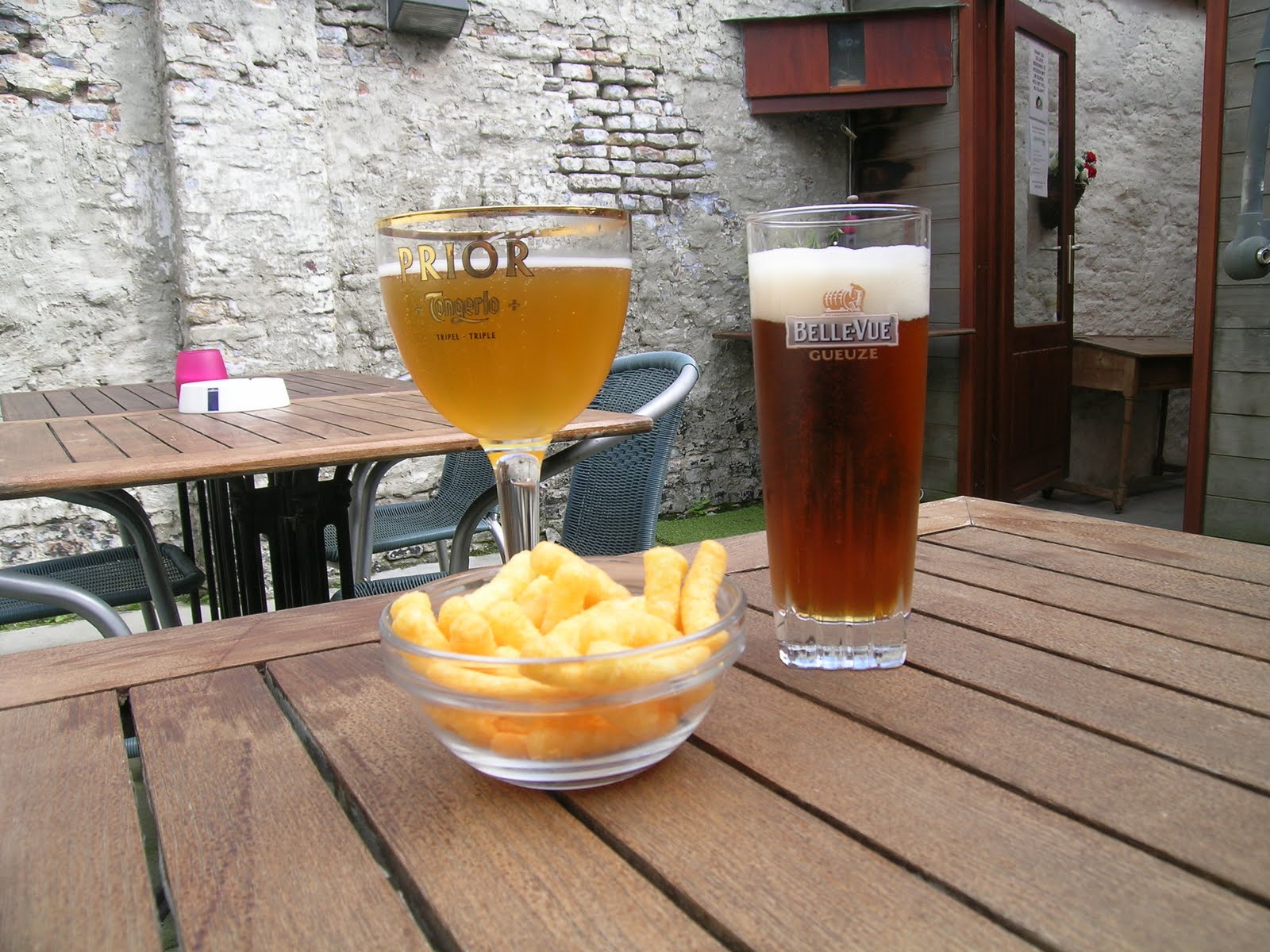
While I was away, I was mostly able to let go of thoughts and worries about what was going on back at the studio. Every once in a while a thought would jab me and I'd break out into a sweat and start shaking, but as it turns out, that worry was for nothing. It's amazing how a bit of worry can keep you from enjoying the moment, like the moment of seeing a real Dutch windmill for the first time or drinking the best beer you've ever had for 2 stinkin' euro. But I'm not paying attention to that, I'm thinking about the one overseas order that came in right before I left and did Ruth remember to double-box it?

Which brings me to this conclusion: there is a big difference between "vacationing" and "traveling." I've been on vacation before, and when I do, I totally forget what I do for a living, what little issues have been biting me on the ass lately, and all the work-related tasks I assign myself while on vacation (yes, I do that, I don't know why.) Riding your bike around Belgium and the Netherlands, while highly enjoyable, is not a vacation. It's travel. Here is a checklist of items that will tell you when you are traveling as opposed to vacationing:

  • You ride your bicycle from a major international airport in a foreign country after a 15 hour plane ride. With no map.
  • You must consult with a country-wide map several times a day to know where you are (bought while realizing you have no idea where you are).
  • You have don't know what to expect from the waitstaff when you walk into the restaurant, or how to order food.
  • You don't have hotel reservations anywhere.
  • You find yourself in a shouting match with an Italian train conductor over the fact that you have hidden two bicycles in the bathroom.
  • An Italian train conductor calls the cops on you.
  • You are happy it's just sprinkling as opposed to downpouring on your 3o km ride through some woods.
  • The high point of your day is a meat and cheese sandwich in the midst of a cow and corn field.


Lest you think I'm whining, let me assure you that part of the reason my husband married me is because I don't whine, or complain, or grouse, when faced with the above situations. I'm totally game for all of it. Because no matter what, when you come right down to it, traveling is so much easier than running a pottery studio.

Monday, September 27, 2010

Sandi Dihl 1953-2010

Right before my husband and I left for Belgium, I received word that my former boss and mentor, ceramic artist Sandi Dihl of Santa Cruz, California, died a few days before after being hospitalized for a week. She had been ill and diagnosed with a terminal disease, but I was unaware of this. It made me feel very sad that I was not able to say good-bye or offer her any comfort at the end of her life. I was even more troubled because I had been thinking of her and wanting to stop in for a visit, but did not have the chance to do so before she died.

I was still a beginner student when Sandi hired me as an assistant in 1994. I often think of the strange coincidence that brought me to her. I was a member of a gym where I struck up a random conversation with another member, who told me she was helping a friend with glazing her pottery. "Really? I would love to do something like that!" I said to this person, who was not as enamored with pottery as I was. She introduced me to Sandi, and I soon had a job that saw me through the next two years as I finished my education in Anthropology at UCSC.

Working for Sandi had as many rewards as it did challenges, and our relationship could be in sister-like harmony or fraught with tension, depending on the day. Sandi was generous, demanding, tempestuous, exacting, and often unpredictable in her moods. Her studio sometimes had the aura of a sorority house with afternoon glasses of wine and giggling stories about her past; other times the grim feel of a factory work floor as we churned out her trademark "wishkeepers" and she reproached herself--and me--with criticism and fault-finding when she found her work to be less than satisfactory.

Sandi was my first model of a self-supporting ceramic artist, and I soaked up every aspect of her achievements so I could create it for myself. Her shortfalls were just as important to my education, and I often joked that working for Sandi made me learn what not to do as much as what to do. The most lasting thing I learned from Sandi was the importance of generosity in the ceramics business: paying employees as well as you can afford, sharing techniques and tricks with others, and encouraging emerging artists as she did me. I would simply not be where I am today without her support and education.

There have been times over the past 5 years as I have been employing my own assistants that I have fully appreciated the crap Sandi had to deal with when she dealt with me. I was not always an easy employee; I bossed Sandi around, told her how she could do things better, and threw it right back at her when she was critical. I was young and a know-it-all. I often tried her patience and she would have jumped at the chance to paddle me on my bottom on many occasions, but she was very proud of my success and her contribution to it when I moved on to open my own studio.

Sandi's health deteriorated noticeably the last few times I saw her, and this picture below is how I remember her and how she looked when I worked for her: pretty, vital, smiling, and always with her dog, Arrow. Rest in peace, Sandi. I never thanked you enough for what you did for me.